
US intervention in Venezuela: power politics instead of international law
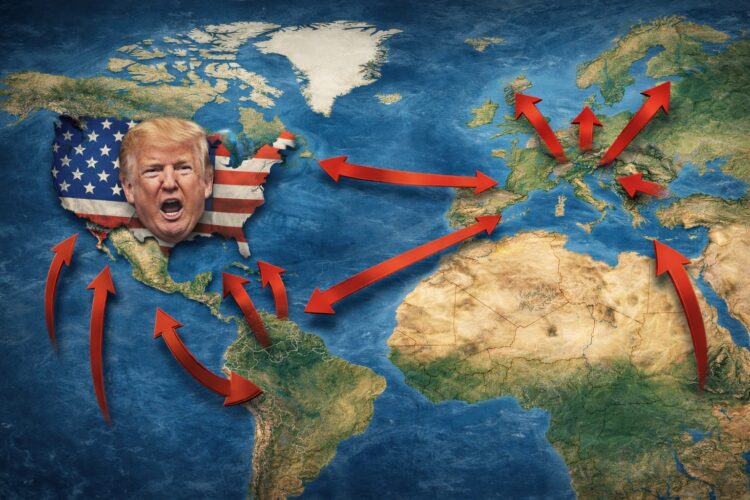
Venezuela reveals the crisis in the transatlantic partnership. With its military intervention, the US has made clear what it has already demonstrated in other contexts: it only supports international institutions and procedures as long as they serve US power claims and interests.
By Prof. Dr. Michael Hüther
Geopolitically, the year 2026 began with a bang: the U.S. military special operation in Venezuela. What is initially surprising is that President Trump—who had claimed he wanted to resolve conflicts worldwide and make peace—has made it clear that he does not shy away from the use of military force. Any hopes of a Nobel Peace Prize can likely be shelved at the White House. Geopolitics has always been power politics; such actions are well documented across different eras and have not lost relevance in recent times. Whether the U.S. power-political calculus will succeed remains to be seen, as the explicit reactivation of the Monroe Doctrine, including the “Roosevelt Corollary,” is unlikely to generate enthusiasm in the southern part of the American continent.
In any case, the U.S. government is sending a signal: it may no longer wish to be the universally engaged hegemon, but when it comes to specific power interests, it is prepared to act decisively. The Venezuela operation also sends a message to Putin and Xi Jinping: military “special operations” are not an exclusive instrument of autocratic regimes, and when the United States chooses this path, one should expect precision, effectiveness, and efficiency. This implies that the U.S. will not limit itself to threats and loud gestures outside the American continent—such as in Iran—if an opportunity for a shift in power presents itself. The chance to weaken the so-called “Axis of Evil,” as coined by George W. Bush in 2002, or to break out strong links in that chain, will not be missed.
There are few moral arguments against the removal of violent rule and corruption. Accordingly, no German commentary fails to point out that neither Maduro nor his wife deserves a tear. For some political and journalistic commentators, a sudden gain in moral altitude suffices to legitimize a breach of the law. Historical precedents are readily invoked. Those especially well-versed cite the case of Noriega in 1989, when the U.S. acted similarly in Panama. But repetition does not create international legal legitimacy, and the United States did not justify its actions by invoking a humanitarian emergency or human rights violations in Venezuela; instead, repeated reference was made to Venezuelan oil reserves.
“However, a repeated act does not constitute legitimation under international law.”
The U.S. military operation in Venezuela stands in contradiction to international law. This does not become irrelevant simply because great powers sometimes behave differently. In any legal system, violations do not invalidate the underlying legal principles. International law, however, does not derive its force—as national legal systems do—from comprehensive codification and undisputed jurisdiction, but rather from the historical practice of dominant states and the institutions that have emerged from it. All of this was ignored by the United States. Equally ignored—presumably deliberately—were the consequences of this action for the standing of international law in the context of “great power competition.”
When German politicians—including the Chancellor—explained their striking silence in the first hours by claiming that “the legal assessment of the U.S. operation … is complex” and therefore requires time, they missed the point. What is complex is the political assessment, not the legal one. Despite all historical influences, the core principles of the Westphalian system remain clear: it asserts sovereignty over territory as the foundation of modern statehood and establishes the principle of non-interference in the internal affairs of other states, as well as the principle of the legal equality of states regardless of their size or internal political order. This is the basis of most Europeans’ criticism of Russia’s war of aggression. Yet even when two actors violate international law in the same way, the political meaning is not necessarily the same.
For Europeans, the political complexity of the Venezuela operation stems from the increasingly questionable transatlantic partnership and Europe’s existing unilateral dependencies on the United States. Negotiations over Trump’s tariffs were always accompanied by a latent American hint that the U.S. need no longer remain engaged in the Ukraine war, which is viewed as a European conflict. The balance of power within the West has shifted because the United States—as outlined in its National Security Strategy—has little confidence in most European states; it diagnoses cultural decay and seeks to counter it by supporting nationally oriented forces. For the Trump administration, security expenditures are justified only in the direct self-interest of the United States, hardly in NATO’s alliance interest, and certainly not in the defense interest of Europeans.
As a result, what has long been necessary remains central for Europe: the development of hard power—through adequate defense efforts, through deeper European integration among those willing, and through strengthening competitiveness. Only in and through Europe can an effective response in the competition among great powers succeed. Given its attractive living conditions, cultural diversity, differentiated educational systems, and other aspects of soft power, the continent—and the EU—has no reason to hide.
This also requires international credibility, particularly in the realm of rules-based international relations. This is crucial because Europeans appear to be the only actors with a distinct will and a deeply rooted historical experience in this area. With the Venezuela operation, the United States has once again demonstrated what it has already manifested in other contexts—the World Trade Organization, the Paris Climate Agreement, and the International Criminal Court founded in 1998: it supports international institutions and procedures only as long as they serve U.S. power claims and interests. This includes the assertion of both the will and the ability to enforce U.S. law extraterritorially.
“In Europe, you can no longer rely on the openness and accessibility of international markets.”
Europe and Germany should be neither naïve in terms of power politics nor careless with international law. This insight goes hand in hand with the recognition that references to a legal system must never be dismissed as mere moral folklore, and that violations of international law can scarcely be morally offset. Otherwise, Europe will not be able to play an appropriate role in the newly emerging global structure. “Europe first” must be the central response to power politics—or more precisely: Europeans must find the courage to use their economic size and significance for clear interest representation. This presupposes that deviant behavior by opportunistic actors within the EU—such as Hungary—has strict consequences, with the principle of the rule of law being firmly enforced.
Economically, all of this means that Europe can no longer rely on the openness and accessibility of international markets and must therefore pursue a Europe-centered trade system through accelerated free trade agreements. This may appear unrealistic given agricultural resistance in France, Italy, and Poland, but the seriousness of the situation must be recognized here as well. Political leadership is required—both European and national. At present, there are few signs of it anywhere. Yet, as so often in history, pressure from circumstances creates new options for action. This begins with coherent communication in the current situation: a violation of international law remains a violation of international law, and power politics only ever escapes it temporarily.
About the author: Hüther has been head of the German Economic Institute (IW) in Cologne since 2004. From 1995 to 1999, he was secretary general of the German Council of Economic Experts. In between, he worked as an economist in the private sector at Deka-Bank. Hüther is deputy chairman of Atlantik-Brücke.
This article was first published in Süddeutsche Zeitung Dossier.
The text first appeared in German and was translated with the help of AI.