
Defense, Debt, Draghi
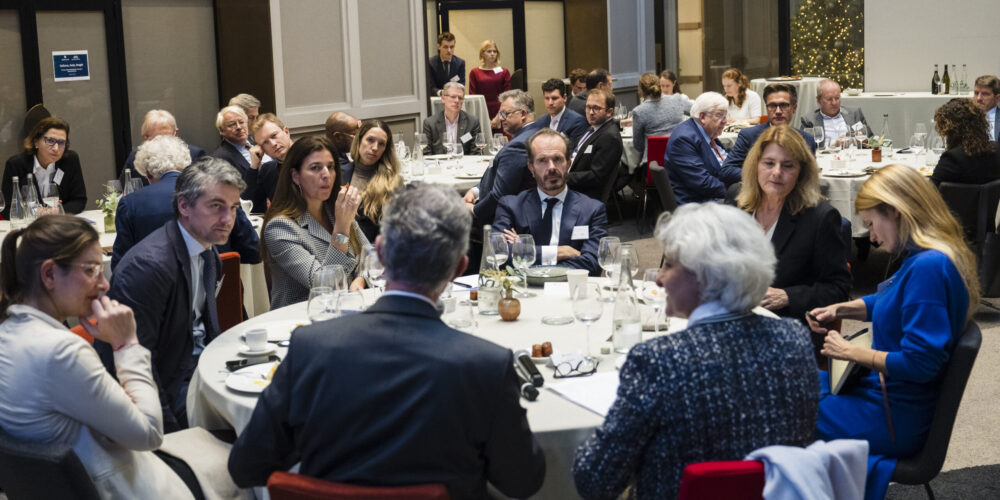 German-French conversations at ODDO BHF Photo: ODDO / Marcella Barbieri
On December 8 and 9, the Atlantik-Brücke brought 40 of its members to Paris. During a series of events, including a full-day conference hosted by ODDO BHF, the members discussed the domestic challenges that Germany and France share, the task of ramping up European defense, and Europe’s role in relation to the United States and the re-emerging geopolitical order. Distinguished speakers at the conference included former German Minister of Finance Jörg Kukies, former French Minister of Defense Sylvie Goulard, former Governor of the Banque de France Christian Noyer, and former German Ambassador to the UN Christoph Heusgen.
This delegation trip was just the first step in the Atlantik-Brücke’s endeavor to facilitate European coordination on pressing geopolitical and geoeconomic matters. The initiative’s core idea is that transatlantic relations have not been purely bilateral for some time and that a strong, cohesive Europe is required for an equal transatlantic partnership. Therefore, the Atlantik-Brücke will continue its mission to promote European dialogue. Following the Paris trip, a delegation of Atlantik-Brücke members will visit Warsaw in March 2026.
Coincidentally, just days before the Paris delegation trip on December 5, after weeks of uncertainty and the constant threat of a serious government crisis, the German Bundestag approved the government coalition’s pension bill. However, it was no coincidence that pension reform was a recurring theme in Paris. Both Germany and France face the challenges of an aging society, an increasingly unsustainable and debt-financed pension system, and a political deadlock that prevents groundbreaking pension reform.
Nicolas Dufourcq, director general of the French public investment bank Bpifrance, highlighted France’s excessive public spending on pensions (14% of its GDP) and the political circumstances that, in a recent compromise to avert a government collapse, resulted in temporarily suspending the pension reform and effectively freezing the retirement age below 63. While the recent debate over pension reform in Germany was less dramatic, Germany cannot escape the underlying problems of demographic change and unsustainable public finances – and neither can anyone else in Europe if they are to follow through on the often-cited Draghi report, restore European competitiveness and build a robust industrial defense base.
Europe Cannot Afford Pessimism
In the realm of foreign policy, our visit to Paris underscored a shared awareness of the emergency that is currently defining Europe, as our guest Ms. Romatet-Espagne highlighted. This sense of urgency shaped the discussions at our joint conference at ODDO. The central question was no longer whether Europe must rearm, but rather, how it can do so and whether joint procurement can finally deliver. In this context, no keyword was mentioned more often in the debate than FCAS (Future Combat Air System). Once hailed as a model of European cooperation, the €100 billion Franco-German-Spanish fighter jet project now risks failure. Nevertheless, the conclusion was not resignation. As Bertrand de Cordoue rightly noted in our interview with him, Europe cannot afford pessimism. Although the fragmented defense industry landscape will not disappear overnight, effective joint procurement remains the most promising path to faster, more efficient, and more credible European capabilities. Convincing societies to invest in defense amid fiscal constraints and aligning military requirements across nations are difficult tasks. However, avoiding these debates would only deepen Europe’s vulnerabilities. As Lithuanian Ambassador Arnoldas Pranckevičius made clear in his keynote speech, the time for endless strategizing has passed. Europe’s security now hinges on translating strategy into concrete action without further hesitation.
Reinforcing the European Momentum
In a world shaped by rivalry and disruption, Europe must reinforce its transatlantic ties and strengthen its other strategic relationships and friendships. French-German cooperation is essential for advancing Europe as a strategic actor and consolidating its newfound strength. As Chancellor Merz establishes Berlin as a European hub for major peace negotiations, Europe has an opportunity to shape outcomes rather than merely react. We at Atlantik-Brücke are committed to doing our part to reinforce this European momentum. Our inaugural European delegation trip to Paris was a milestone in our renewed European strategy. We will continue to strengthen ties across the continent and build a network of partners and allies prepared to address the challenges of our time. The time is now to reinterpret the transatlantic relationship and engage with our allies on an equal footing.