
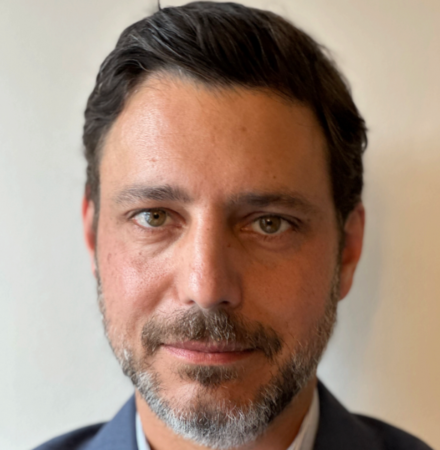
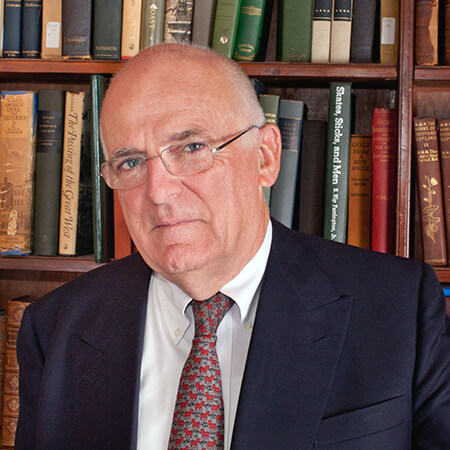
At the London Regional Chapter event “Artificial Intelligence and the Future of Espionage”, held on April 27 at the Warburg Institute, Sir Richard Dearlove, former Chief of the British Secret Intelligence Service (MI6), and Dr. Anthony Vinci, former Chief Technology Officer and Associate Director for Capabilities at the National Geospatial-Intelligence Agency and author of “The Fourth Intelligence Revolution: The Future of Espionage and the Battle to Save America”, discussed how artificial intelligence is reshaping the future of espionage. The discussion was moderated by Ray Eitel-Porter. Read a short interview with Sir Richard Dearlove and Anthony Vinci on this topic here.
How do you assess the trade-off between open AI development and closed, controlled systems in terms of national security and global stability—and where do you think the line should be drawn?
Dr. Anthony Vinci: Open versus closed AI development is the most important question of our time. Open AI development, as in the US, moves much faster and is likely to achieve AGI sooner – a world changing event. But AI, especially AGI, is very powerful technology that has immense downsides in terms of the possibility of dystopian levels of total surveillance, intractable disinformation operations and new forms of warfare. While China is already closing off its AI for internal security concerns, the US is very open – so far – but I assess will soon begin to regulate and perhaps limit public access to the most powerful model features.
Sir Richard Dearlove: There is no generic answer to this question. Dangerous AI capabilities, once identified as such, should be subject to control and not allowed to proliferate. However a balance has to be struck with innovative technologies which should not be stifled by a narrow approach to the needs of national security. Clearly a mixed ecosystem would be the preferred solution—so this would imply some sort of advisory technical committee steering policy with regard to the threats to national security from the rapid advance and introduction of new AI systems. Tracking the activity of hostile and privateer actors (both state and commercial) would also be an important intelligence requirement. However the ultimate goal must be the creation of an international regulatory regime to include China—which would mimic the the SALT and OPCW arms control agreements of the late Cold War. The issue ultimately is ‘whole societal’ and therefore not simply a dimension of national security and defence policy.
From an intelligence perspective, does restricting access to advanced AI models—like the approach taken by Anthropic—actually reduce risk, or does it create blind spots compared to more open ecosystems historically associated with OpenAI?
Dr. Anthony Vinci: It’s the job of the state to secure society and I believe that a new role of intelligence agencies should be to help assess the potential damage from releasing new technologies, particularly the most powerful AI models. CISA and the NSA, for example, may be best placed to assess the ramifications of Mythos’ cyber security threat. I do think that governments should retain the ability to use such models in order to best ensure national security. But as with any potentially dangerous technology, such as bioweapons, government’s should also have the ability to limit access by the public or other nations. This seems prudent to me.
Sir Richard Dearlove: In the case of Anthropic I believe that the company’s decision on non-release to the general public was sensible and justified—though it was also a clever advertising gimmick. My experience of cybersecurity in public companies, especially in financial services, is that insufficient senior management time, attention and resources are given to their IT security. Main boards tend to leave the matter in the hands of technicians without assessing fully their strategic vulnerabilities—that is until things go catastrophically wrong (witness what happened to Marks and Spencer and Jaguar here in the UK). So here again one sees the pressing need for a clear regulatory framework for intrusive AI systems which can find hitherto unidentified faults in software. This applies as much to the state sector as it does to the commercial. However I should add (having been trained as a poacher rather than a game keeper) that the intelligence gathering capabilities of Claude Mythos would appear to be far reaching.
If a Stanislav Petrov–type scenario occurred today in an AI-driven early warning system, would a human still realistically have the time, authority, and willingness to override it—or have we designed modern defense systems in a way that makes that kind of intervention unlikely?
Dr. Anthony Vinci: Yes, I think things are already moving too fast for decisions in some spheres, certainly at the tactical level. The world will only move faster going forward. However, one useful aspect of AI is that it helps us to comprehend very complex information and situations, that includes thinking through unlikely events. I think that this can help us to wargame out possible Stanislav Petrov–type scenario. It is not foolproof, of course, but thinking ahead better is the best way to prepare to make decisions.
Sir Richard Dearlove: My understanding is that we are still some distance from the human element being written out of missile defence system by AI. Once again I think that the answer has to be a mixed ecosystem where AI enables rather than substitutes for human judgement. We should perhaps regard AI as a potential protection against faulty interpretation of data. Personally I cannot see round the clock human vigilance being dispensed with; but I do appreciate the complexity of what I am suggesting. It points towards the need for the creation of a permanent regulatory body designed to proof a global international security system against accidental interpretations. Underlying this would of course be national security structures designed to ensure confidence in such systems. As Pax Americana disappears one can begins to discern the sort of structures which might and should replace it. The key question will be at what point will there be sufficient trust between the world’s primary power blocs to put these issues at the very top of their security agendas—and initiate the slow and complex task of negotiation.