“Society has already become something its politics has not yet agreed to be”
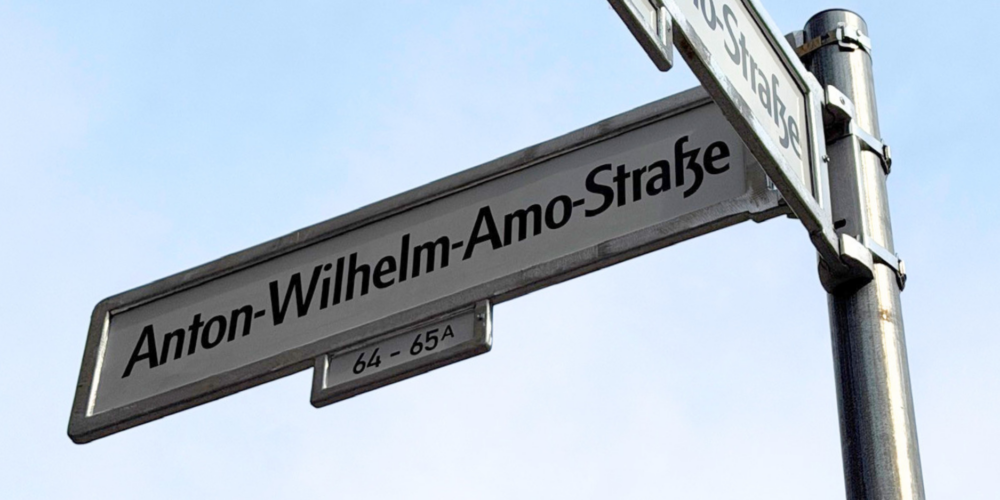 Anton-Wilhelm-Amo Straße in Berlin
Reflections on migration, memory, and belonging from the New Bridge Program, Class of 2026
By Anas El Yousfi
Spend some time in Germany and you will meet a country that is visibly and functionally multicultural. More than a quarter of Germany’s residents now have a migration background, and in 2024 the country naturalized nearly 292,000 new citizens, the most since it began keeping records. Then read the headlines from the same country: fast-track citizenship abolished, family reunification suspended for many migrants, border control turned into the government’s defining issue. I grew up multiculturally, with family from all over the world, so questions of migration and belonging have never been abstract to me. Maybe that is why, traveling through Washington, Brussels, and Berlin this spring with the Atlantik-Brücke New Bridge Program, I felt like I was watching two Germanys describe themselves at once. The society has already become something its politics has not yet agreed to be, and the space between them is where nearly every conversation we had seemed to end up.
A roundtable on migration and integration at DeZIM (German Centre for Integration and Migration Research) in Berlin gave that gap a history. We met with researchers who study integration and with a representative of the Turkish German community, whose story begins in 1961, when Turkish workers were recruited to help rebuild the postwar economy. Sixty-five years later there are fourth-generation Turkish Germans, yet for most of that time integration was treated as a test migrants had to pass rather than a process the whole society took part in. Germany did not officially describe itself as a country of immigration until this century, long after it had become one in practice.
“Which parts of the past a country chooses to remember says a great deal about who it considers its own.”
A walking tour of Berlin’s colonial history extended that theme further back in time. Germany’s memory culture is rightly admired. The Stolpersteine, small brass plaques set into the sidewalk in front of the homes of people deported and murdered by the Nazis, are impossible to walk past without pausing. But the tour also covered histories that receive far less attention, including Black Germans persecuted under Nazi rule and the colonial-era crimes Germany has only recently begun to confront. It formally acknowledged the genocide of the Herero and Nama peoples in Namibia only in 2021. Our tour ended at a subway station recently renamed for Anton Wilhelm Amo, an African-born philosopher who taught at German universities in the eighteenth century, after decades of public campaigning against the colonial-era name it replaced. Which parts of the past a country chooses to remember says a great deal about who it considers its own.
That question followed me personally as well. When I introduced myself in Germany, people would sometimes ask where I was really from. The question was never hostile, and I understood the curiosity behind it. But Turkish Germans hear the same question in their own country, in their own language, three generations in. Living in a country and being counted as fully part of it are not the same thing, and that small question marks the distance between them.
That distance is now the central fight in German politics. We took a regional train east to Frankfurt an der Oder, a small city on the Polish border, where we met local officials and journalists who described how their region is changing. Eastern Germany is where the far right performs best, often in places where relatively few migrants actually live, which suggests the anxiety has less to do with actual neighbors than with a story about national identity under threat. A panel on democracy and participation raised the other side of the same issue: whether people with migration histories can move from being the subject of policy debates to taking part in them. The far right’s answer is a permanent no. Germany’s democratic future depends on a better one.
As an American, none of this felt entirely foreign, just a bit different. The United States calls itself a nation of immigrants and debates constantly over what that means, and Germany is telling itself a more hesitant version of the same story. What I took home was less a verdict than a sense of direction. Multicultural Germany is not a proposal that can still be voted down. It already exists, at record scale. The real question is how long its politics takes to catch up with its people. I’ll be watching for Germany’s answer, because in the United States, we’re still working on our own.

Anas El Yousfi is a technologist working at the intersection of data, technology, and society. Raised Moroccan-American in New York with family across Western Europe and beyond, he grew up immersed in the questions that define the transatlantic relationship, with a deep interest in geopolitics and how AI and emerging technologies are reshaping governance and public life on both sides of the Atlantic. He’s a 2026 fellow of the New Bridge Program.
The New Bridge Program is supported by the Transatlantic Program of the Federal Republic of Germany, funded by the European Recovery Program (ERP) of the Federal Ministry for Economic Affairs and Energy (BMWE), and by the Joachim Herz Foundation.