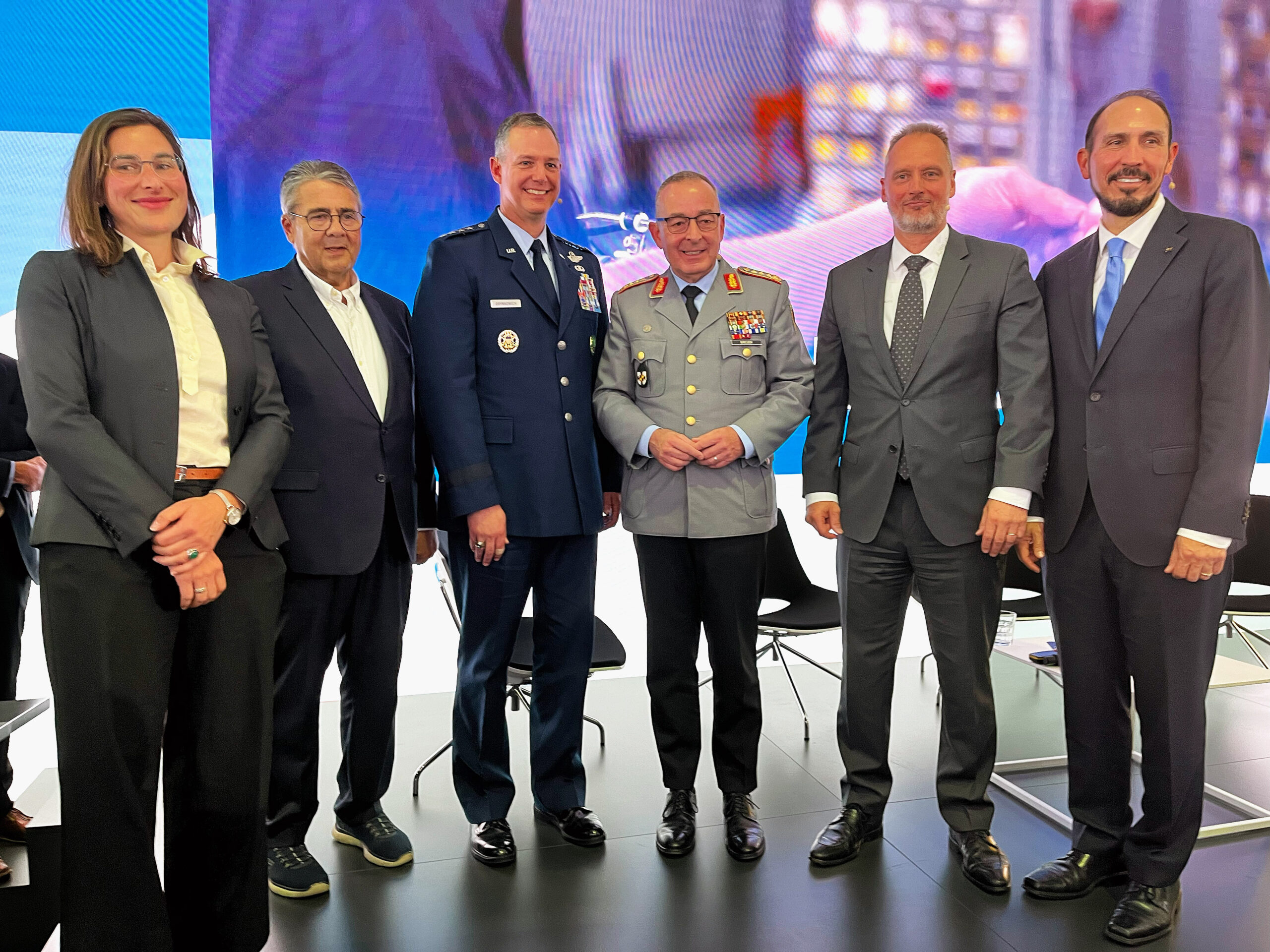

At the Atlantic Bridge’s SACEUR talk during the ILA in Berlin, Breuer and Grynkewich called for pace and honesty – and set 2029 as a binding deadline for Europe’s defense buildup.
This year (June 11, 2026), the Atlantik-Brücke hosted its traditional SACEUR talk at the ILA aerospace show in Berlin. The high-profile discussion brought together General Carsten Breuer, Chief of Defense of the Bundeswehr; General Alexus Grynkewich, NATO’s Supreme Allied Commander Europe (SACEUR); Airbus Defence and Space CEO Michael Schöllhorn; and OJ Sanchez of Lockheed Martin – to discuss Europe’s progress in defense, but also to lay bare its remaining gaps, as the continent works to restore its military credibility. The panel was moderated by Robert Wall (Aviation Week).
“This is the first time that the Atlantik-Brücke has held its traditional talk with the Supreme Allied Commander Europe and the Chief of Defense of the Bundeswehr in public,” said Sigmar Gabriel, Chairman of the Atlantik-Brücke, in his welcome remarks. “It is also our premiere with General Alexus G. Grynkewich. And General Carsten Breuer is a steadfast partner in our security policy dialogue.”
“Even six to eight years ago, I couldn’t have imagined holding a discussion about the shift in attitude within the Bundeswehr and the defense industry,” Breuer affirmed.
“2029, this is where it counts. And this is the reason why I put a red line on all our timescales in the Ministry of Defense.”
[related] A recurring theme of the discussion was time. Breuer described how he has drawn a firm deadline in his ministry’s planning: “2029, this is where it counts. And this is the reason why I put a red line on all our timescales in the Ministry of Defense.” He repeatedly pressed for openness between politics, industry, and the armed forces, warning that timelines can no longer simply be pushed back. “We have to be honest to ourself,” he said, arguing that if a goal set for 2029 cannot be met, “then we have to discuss how to mitigate this, because there is no other chance.”
The panelists pushed back on the notion that Europe remains a “paper tiger.” “Most allies have increased their defense budgets. Last year, for the first time, all allies met the target set at NATO’s Wales summit,” said Grynkewich. He cautioned, however, that money alone does not create capability – it requires “delivery through an industrial base that’s healthy, that’s innovative.” “It would be wrong to say that Europe has no defense capability at all. The money is now being made available. We in the defense industry have to ramp up the innovation of our products,” Schöllhorn said, stressing: “The defense industry and the procurement system have to work even more closely together.”
The thorniest capability gap lies in long-range precision strike
The thorniest capability gap discussed on the panel lies in long-range precision strike. Breuer outlined a three-step approach – first relying on US capabilities, then procuring systems, and finally building a European solution – while acknowledging the uncertainty around the first two steps. His guiding criterion, he stressed, is availability by the 2029 horizon: systems must be procured “whenever they are available,” depending on what the market and development timelines allow. “We have to establish transparency about the red lines of our objectives. That means by 2029 we have to have been honest with ourselves. After that, we can no longer afford any delays. If a specific goal is at risk, we have to ask ourselves how to mitigate the resulting threat.”
“As for Europe’s capabilities in long-range precision strike, it’s clear that within NATO and from the US perspective we need certain air and maritime capabilities under certain conditions,” Grynkewich emphasized. And he analyzed: “Long-range weapons help the alliance establish deterrence in the short term. In the medium and long term, long-range precision strike has to be complemented by cyber and space capabilities. For that, research and development has to be adapted.”
“Lockheed Martin is rapidly ramping up its industrial manufacturing capacity. All our systems have to contribute to enabling long-range precision strikes,” Sanchez assured.
“Whoever is able to master the data, is gonna have a decision advantage.”
Both generals converged on a deeper point: networking matters more than individual platforms. “It is all about the data,” Grynkewich said. “Whoever is able to master the data, move it more quickly, apply more effective algorithms to it, is gonna have a decision advantage.” The two industry representatives reiterated the call for common standards, and Breuer warned against deferring standardization: “Don’t delay it because we don’t have the time.”
On the alliance’s future shape, Grynkewich framed a lighter American burden as a strength rather than a retreat. Asked what a transatlantic alliance looks like if the US carries less of the load, he answered: “It looks stronger. It looks more sustainable.” He situated this within a “NATO 3.0” concept that gives Europe a more balanced voice.
Asked about a hypothetical scenario in which Russia were to attack the Baltic states, the SACEUR was unequivocal: “Absolutely we’re ready to fight tonight. We’re ready to fight tonight across all 32 nations.” Breuer added: “Our problem is not within the alliance. Our problem sits in Moscow, and therefore we have to do something against this.”
“Absolutely we’re ready to fight tonight. We’re ready to fight tonight across all 32 nations.”
Breuer closed the discussion with praise for the transatlantic partnership: “I’m absolutely glad to have an American SACEUR here, because this provides – apart from General Grynkewich himself – that transatlantic link, which is also what the Atlantik-Brücke is all about. I think it’s good, and we should keep it this way as long as that’s possible.”