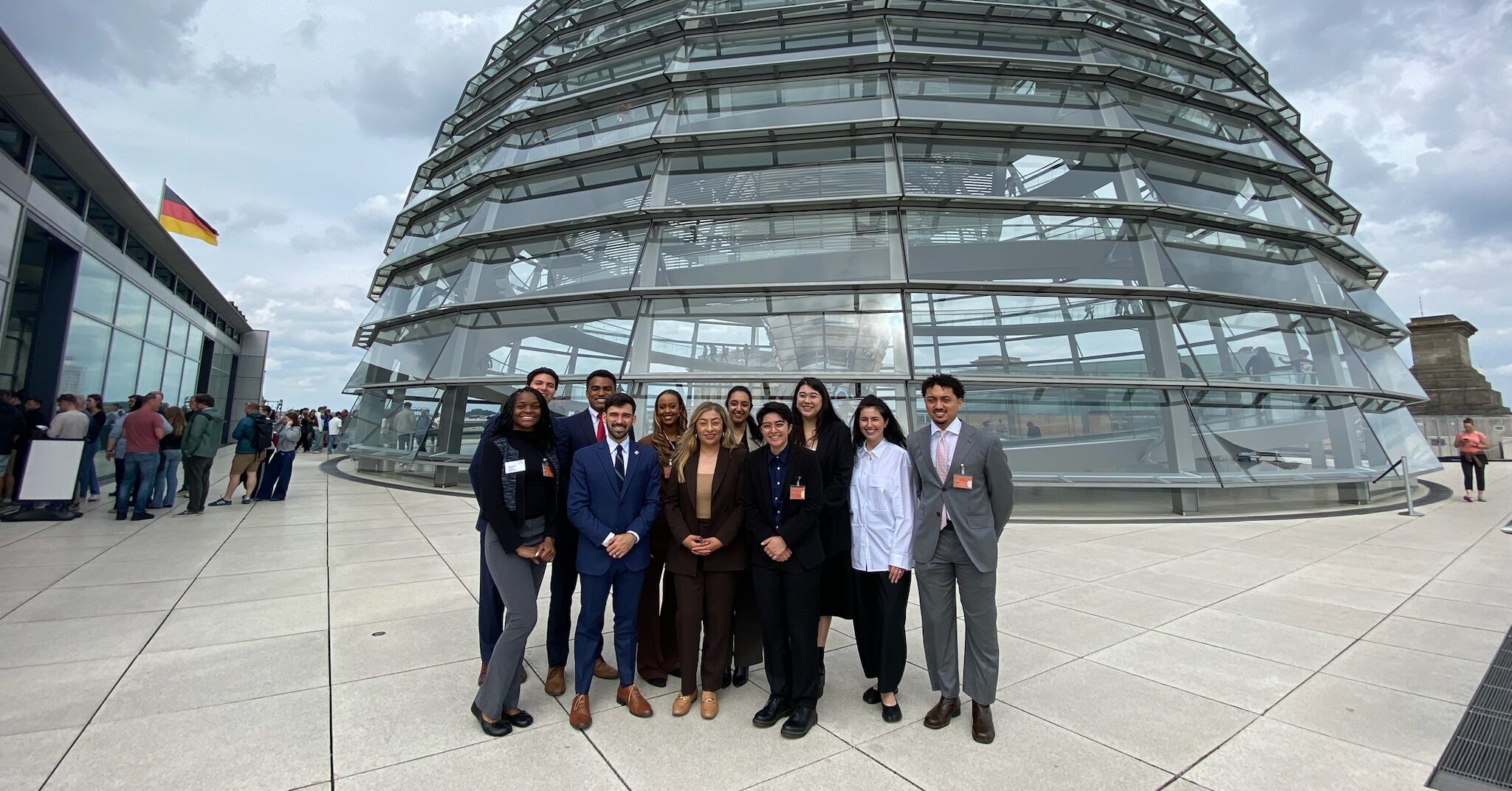

Alumnus Neal VanMarter’s Reflections on the 2026 New Bridge Program to Germany.
I arrived at the New Bridge Program carrying a familiar American question: Is Germany prepared to assume greater responsibility for Europe’s defense?
As a U.S. Army veteran and former military and veteran liaison in the United States Senate, I have seen security policy from both the institutional and human sides. I understand why Americans expect capable allies to share the responsibility of deterrence. But after discussions in Washington, Brussels, Berlin, and Frankfurt (Oder), I returned with a more complicated and more urgent understanding of the challenge. The question is no longer simply whether Germany and Europe will spend more. It is whether those investments can be translated quickly enough into military capability, industrial readiness, technological innovation, and lasting public support.
Our conversations about Russia’s war against Ukraine and the future of transatlantic security made clear that Europe’s security environment has fundamentally changed. At NATO Headquarters, we examined how the Alliance’s strategic priorities are being put into practice and how Germany operates within a consensus-based institution of 32 sovereign democracies. In Berlin, our discussions explored how changes in U.S. foreign policy are influencing German and European calculations, as well as how industrial, energy, and innovation policy increasingly intersect with national security. These exchanges challenged me to look beyond defense spending as a percentage of gross domestic product. Spending commitments are indispensable, but budgets do not deter adversaries on their own. Deterrence requires forces that can deploy, equipment that can be sustained, supply chains that can withstand disruption, and an industrial base capable of producing at the speed and scale a crisis demands. That distinction has only become more relevant since our fellowship. NATO Allies have committed to investing 5 percent of GDP in defense and defense-related requirements by 2035. At the 2026 NATO Summit in Ankara, Allies announced more than $50 billion in new procurements and committed to expanding collective manufacturing capacity and accelerating innovation. These are significant steps, but 2035 cannot become permission to postpone what Europe needs now. The threat is immediate. Ukraine cannot wait years for promised support, and NATO cannot afford procurement and production timelines built for a more predictable era.
Europe possesses extraordinary scientific expertise, advanced manufacturing, and a growing defense-technology sector.
The challenge is connecting those strengths to operational requirements at the speed of the threat.
Ukraine has demonstrated the importance of drones, artificial intelligence, electronic warfare, resilient communications, and the rapid adaptation of civilian technology for military use. NATO must create more accessible pathways for start-ups and nontraditional suppliers, accelerate testing and procurement, and give established manufacturers the predictable, long-term demand required to expand production. Readiness five years from now will matter little if aggression succeeds in the meantime. This urgency also requires sustained financial and military support for Ukraine. That support is not charity; it is an investment in the principle that borders in Europe cannot be changed by force. If Russia is allowed to benefit from violating Ukraine’s sovereignty, the consequences will extend far beyond Ukraine. Other states will reasonably question whether international commitments can protect them, or whether only possessing their own nuclear weapons can guarantee their survival.
[related] That is a path Europe and the world must avoid. The answer is not a cascade of new national nuclear arsenals. It is credible collective defense: strong conventional capabilities, reliable alliance commitments, and unmistakable political resolve. NATO must demonstrate that no country will be permitted to redraw European borders through invasion while ensuring that deterrence prevents escalation rather than accelerates it. Our visit to Frankfurt (Oder), on Germany’s border with Poland, added another dimension to this lesson. In Washington and Brussels, security is often discussed through strategies, institutions, and spending targets. In Frankfurt (Oder), conversations about local government, journalism, business, and regional identity illustrated that alliances ultimately depend on the confidence of the communities they protect. Defense investments must therefore be accompanied by an honest public explanation of why they are necessary and how they contribute to security, economic resilience, and democratic stability.
Germany’s history understandably shapes how it approaches military power. The New Bridge Program helped me appreciate that historical restraint while recognizing that responsibility takes different forms in different eras. Today, responsibility requires Germany to help ensure that Europe can defend itself, support Ukraine, and deter further aggression. It also requires the United States to treat stronger European capacity as an investment in our shared security, not a retreat from American leadership.
The transatlantic debate has moved beyond whether Europe must do more. The task now is turning resources into readiness before the next crisis tests our promises. That will require political courage, faster institutions, sustained support for Ukraine, a revitalized defense industrial base, and an innovation ecosystem capable of moving at unprecedented speed. The future of the Alliance will be determined not by the commitments its members announce for the next decade, but by the capabilities and the resolve they build together now.