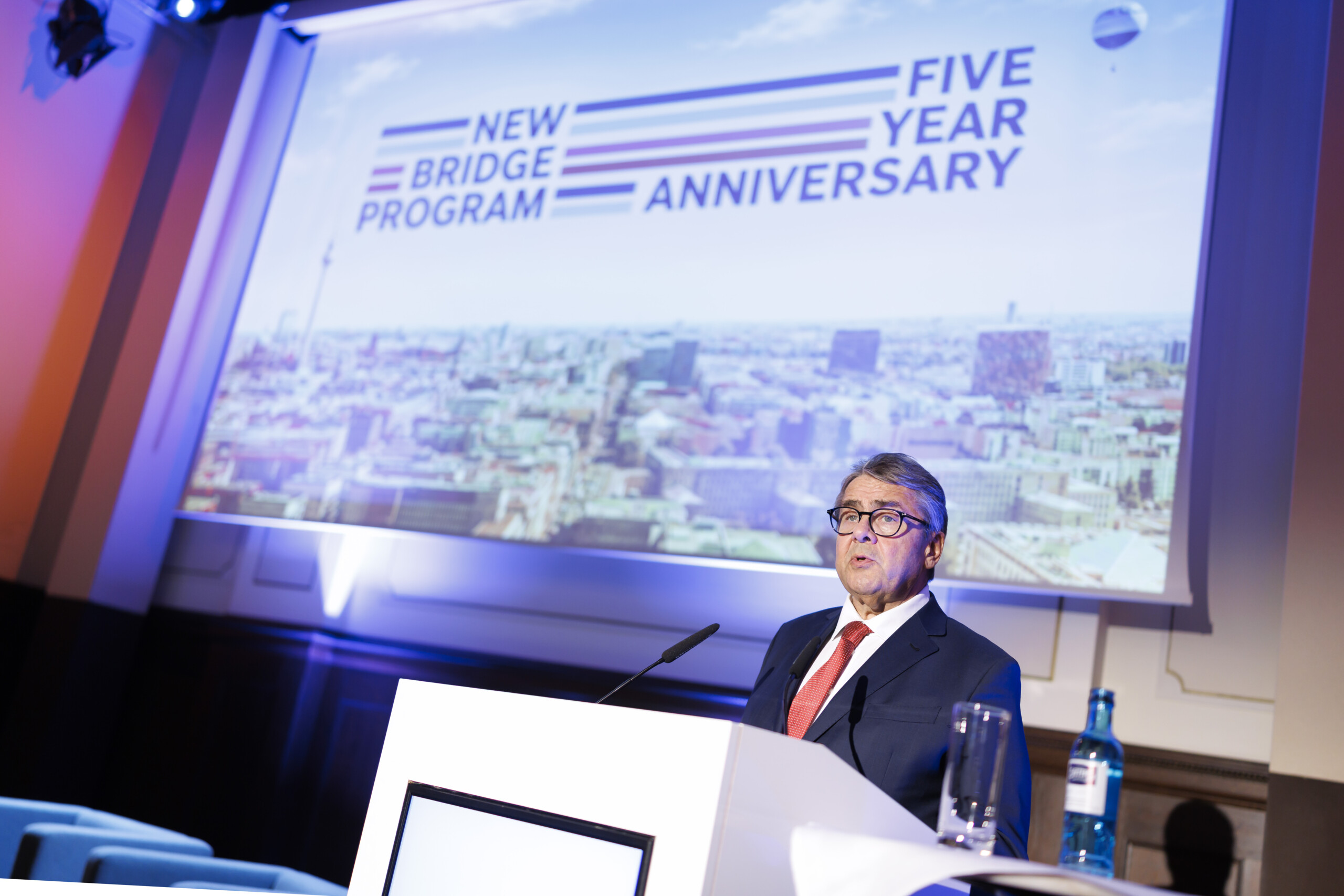

Five Years of the New Bridge Program
A report on the anniversary event by Esra Güner, 2023 New Bridge to the US alumna.
“We want to make this program weatherproof.” Sigmar Gabriel made his vision for the future clear in his opening remarks at the celebration of the New Bridge Program’s fifth anniversary. As he put it, “bridges are built precisely for the places where the ground gives way.” His words could hardly have been more timely: as relations between Germany and the United States come under growing strain, building and maintaining bridges across the Atlantic becomes more important than ever.
And yet, despite the challenges facing transatlantic relations, there was little sign of distance or division in Berlin’s Meistersaal on November 16, 2026. Alumni from ten U.S.-to-Germany cohorts and four Germany-to-U.S. cohorts came together to celebrate, exchange perspectives, reconnect, and already make plans for future collaborations. Their enthusiasm was a powerful reminder that transatlantic relations are about more than politics: they are built on personal connections, mutual understanding, and a shared commitment to keeping the dialogue alive.
This vision was also at the heart of Gabriel’s remarks. Looking ahead, he emphasized the importance of ensuring that the bridge built by the New Bridge Program will serve generations to come. Building bridges, he suggested, also means looking beyond established geographical and political centers. He stressed that the “most interesting conversations do not happen in Berlin and Washington.” This is precisely why the NBP seeks to “reach beyond the traditional centers”. To make this vision a reality, Gabriel also expressed his sincere gratitude to all supporters of the program, including the Joachim Herz Foundation.
The panel discussion that followed explored German-American relations from a variety of perspectives. One question in particular invited the panelists to reflect on what each side could learn from the other: What does the other country do better? For panelist and Policy Advisor Raze Baziani-Körber, one answer was clear: Americans tend not to wait too long. They are more proactive when it comes to making decisions and addressing problems. Julia Friedlander, CEO of the Atlantik-Brücke, echoed the call for greater initiative on both sides, pointing out that progress requires more than hope. “Hope comes with active suggestions and propositions,” she emphasized. At the same time, Friedlander made clear that transatlantic relations should not be taken for granted. Strong alliances, she argued, are a force multiplier for the success of American foreign policy.
Neal VanMarter, who had recently celebrated the victory of the candidate for whom he had served as Deputy Political Director in Georgia’s midterm elections, offered a similar perspective on political success. For him, the key lies in genuine representation: “Candidates need to reflect the community. They should not only look good on the screen.” His observation highlighted the importance of political figures who remain connected to the people they seek to represent.
Yet the discussion was about more than politics and international relations. It also addressed the personal courage required to keep dialogue alive across differences. For Julia Friedländer, this starts with a simple but powerful step: “Talk to someone who doesn’t understand you automatically.” Omid Nouripour, Vice President of the German Bundestag, likewise stressed the importance of having the courage to disagree – particularly in challenging times. As he pointed out:
Democracies are built on disagreement.
The evening, moderated by NBP alumna Sanga Lenz, concluded with an optimistic outlook on the future of the New Bridge Program. Its mission remains as relevant as ever: bringing younger and underrepresented professionals into transatlantic dialogue, opening up traditionally established networks to broader perspectives, and fostering lasting cross-cultural connections.
Even when political waters become increasingly turbulent, bridges must remain strong. The New Bridge Program does precisely that by connecting people and perspectives that might otherwise never meet – and by ensuring that transatlantic dialogue extends beyond established political and professional circles.
As an alumna, the anniversary was a particularly meaningful occasion for me. It filled me with pride to look back at what the program has achieved over the past five years, and with gratitude to see that future generations will have the opportunity to strengthen the bridge on which we stand today.
As Julia Friedlander put it that evening, reflecting on politicians who describe relations between Germany and the United States as being at rock bottom: “Come to us. And you will realize the absolute opposite is the case.”
Here’s to the New Bridge Program!