
The New Bridge to the U.S. program led this year’s group from the corridors of power in Washington to a historic cottage in Philadelphia. There, a civil rights activist explained why she refuses to give up. Report by NBP alumna Narîn Şevîn Doğan.
By Narîn Şevîn Doğan
For several months now, our work in foreign reporting has been dominated by the upcoming U.S. midterm elections. These elections can also affect our lives here in Germany – against the backdrop of a historically deep-rooted relationship between America and Germany that is becoming increasingly strained.
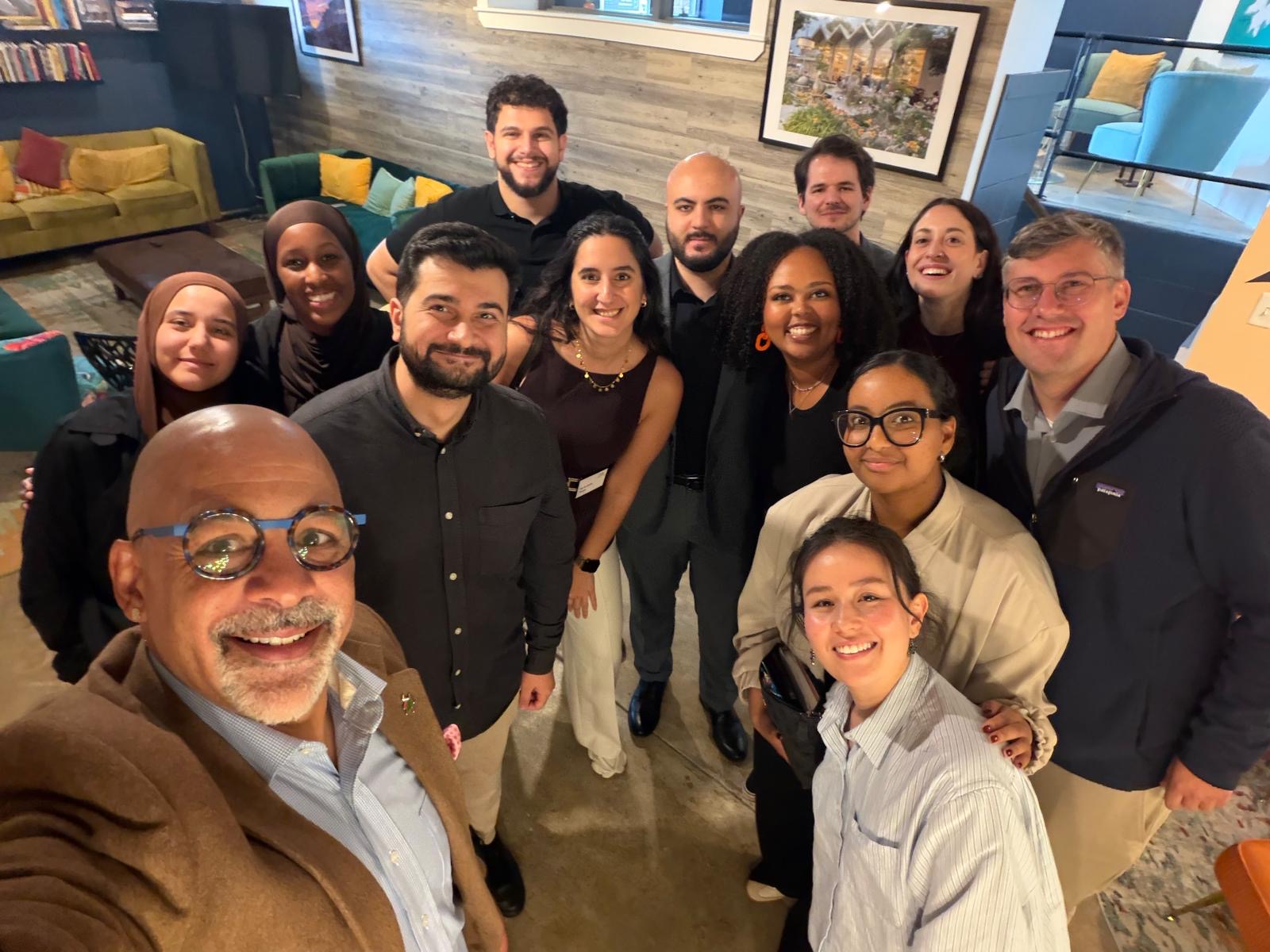
It was the perfect time to travel to the States to meet decision-makers and representatives from the business community and civil society who are just as moved by these times as I am – and as are the other nine fellows with whom I participated in this year’s New Bridge to the U.S. program. What better place to start such a journey than Washington? The center of power for the U.S. government. It’s where President Donald Trump continues to shake up the political scene even in his second term and repeatedly causes outrage with his statements and decisions.
Both the Chancellery in Berlin and the Department of State in Washington assure us that transatlantic relations are strong, despite contradictory – and at times hostile- statements by the U.S. president. Germany still has a great deal in common with America, the Chancellery states. At the State Department, Germany is described as a “close partner to this day, even with differences.” And yet, a sense of uncertainty can be felt in the nuances. This confirms the assumption: The world order, as it has existed for decades, appears to be undergoing a fundamental shift. Germany can no longer rely entirely on the U.S. as a partner. They are calling for Germany to play a more dominant role on the world stage, particularly with regard to security policy.
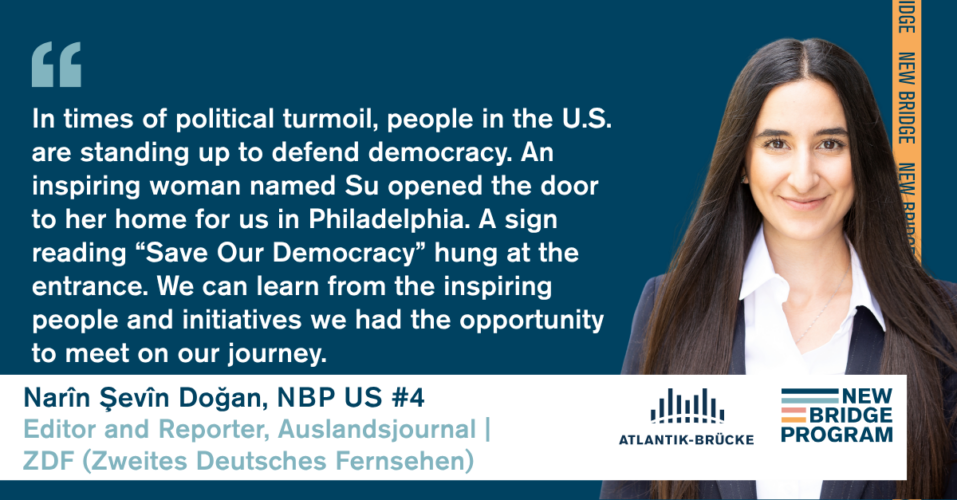
Our journey continues from Washington to Philadelphia. A city that surprises me, a city with spirited people who leave a lasting impression on me. Here, too, I sense concern about an unpredictable President Trump. During a city tour with Matthew – which aims specifically to highlight underrepresented perspectives, including those of the African American community – we happen to meet Su. She lives on Elfreth’s Alley, the oldest continuously inhabited residential street in the United States. Hundreds of tourists walk through here every day. You’d think that would really annoy the residents. Su, however, with her bubbly, warm, and hospitable personality, spots our group and spontaneously invites us over to her place. This is the U.S. as I imagined it: friendly people who strike up conversations even with complete strangers and share a bit of their lives, driven by passion. Su has lived with her husband for a long time in the small historic cottage into which we squeeze ourselves.
“Black history is not separate from American history. It is American history.”
Su tells us about the sights at Independence Hall, which we had just visited shortly before. She also tells us about the panels at the President’s House Site, a memorial to George Washington, the first president of the United States, which for a long time also commemorated the enslaved people owned by Washington himself. President Donald Trump had ensured that new panels were installed. The language in these panels downplay the brutality of slavery and Washington’s role in it. This upset Su terribly as an activist who participated in the “No Kings” protests, and has a hand-painted sign reading “Save our democracy” next to her front door. She lived through the era of Martin Luther King Jr and is convinced that “Black history is not separate from American history. It is American history.” Civil rights are important to her. “We can never give up,” she tells us as we part ways, determined to continue fighting to preserve her rights.
The midterm elections on November 3 will determine whether Donald Trump can continue on his current path with the backing of the Senate and the House of Representatives, or whether things could get more uncomfortable for him should there be a “blue wave” – that is, significant gains by the Democrats. The Democratic Socialists of America (DSA), in particular, have had some successes. In the New York City mayoral election Zohran Mamdani was victorious. And in the 2026 primaries, candidates affiliated with or supported by the DSA won seven of the 25 U.S. House of Representatives primary races they contested. One of the DSA-backed primary winners is Chris Rabb, who ran in the Democratic primary in Pennsylvania. We met the approachable candidate – who prefers to be called “RepRabb”- in the Germantown neighborhood of Philadelphia. Our discussion with him focused primarily on the challenges within the Democratic Party, which is embroiled in a battle over its direction and the party will need to position itself well ahead of the 2028 presidential election. Meanwhile Rabb is confident of his victory and his election to the House of Representatives.
We, as alumni of the New Bridge to the US program continue to monitor developments from Germany, now with new, strong connections in the U.S. and even greater anticipation regarding the outcome of the midterm elections.